
invoicing
Invoice vs. Receipt: What's the Difference (and When You Need Each)
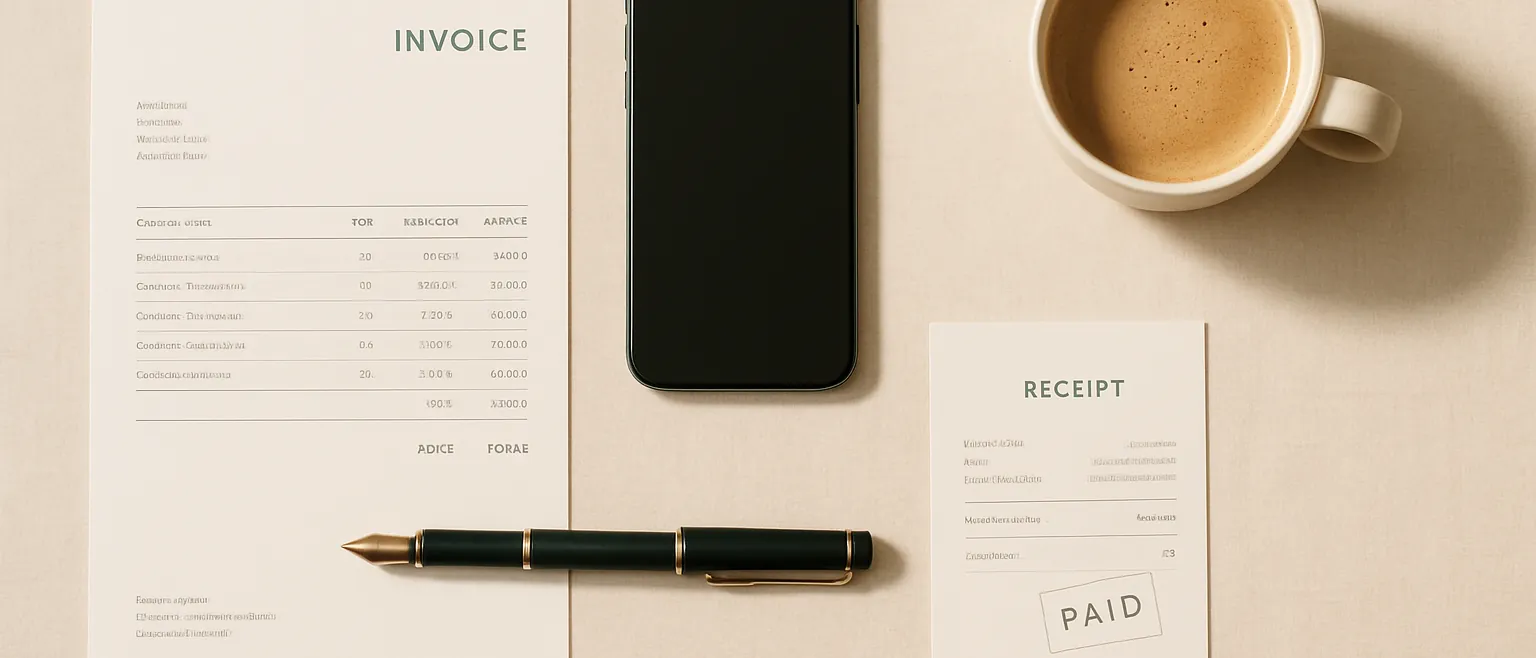
An invoice asks for money; a receipt confirms you got it. An invoice is a request for payment you send before a client pays. A receipt is proof of payment you issue after the money arrives.
That single distinction — request versus proof, before versus after — is the whole thing. But it has real consequences for how you get paid, what your bookkeeping looks like, and what you hand a client (or the tax office) when someone asks for “the paperwork.” Here is how each document works, and when to use which.
What an invoice is
An invoice is a formal request for payment for goods or services you have provided. You issue it when the work is done — or delivered on agreed terms — but the money has not come in yet. Its job is to tell the client exactly what they owe, why, and how to pay it.
A complete invoice includes:
- A unique invoice number, for your records and theirs
- Your business name and contact details, and the client’s
- The invoice date and the payment due date
- An itemized list of goods or services, with quantities and rates
- The subtotal, any tax, and the total amount due
- Payment terms and accepted payment methods
The defining feature is that an invoice looks forward: it names an amount that is still owed and a date by which it should be paid. If you are not sure how to set that due date, our guide to net 30 and other payment terms walks through it.
What a receipt is
A receipt is proof that a payment was made. You issue it after the client pays, and its only job is to confirm the transaction is complete. Where an invoice looks forward to a payment, a receipt looks back at one.
A receipt is usually simpler than an invoice. It needs:
- Your business name and contact details
- The date payment was received
- The amount paid, and the method (card, bank transfer, cash)
- What the payment was for — often a reference to the original invoice number
- Any remaining balance, if it was a partial payment or deposit
Because it records something that already happened, a receipt carries no due dates or payment terms. It says, in effect, “paid in full on this date” — nothing more.
Invoice vs. receipt at a glance
The two documents differ on four things that matter:
- Timing — an invoice goes out before payment; a receipt after.
- Purpose — an invoice requests money; a receipt confirms it was received.
- Detail — an invoice itemizes the work and the terms; a receipt mostly records the amount paid.
- What it proves — an invoice proves money is owed; a receipt proves money changed hands.
A handy way to remember it: you send an invoice to get paid, and you give a receipt because you were paid.
When do you need each?
It depends on how and when the money moves.
- Deferred payment — freelance projects, B2B work, anything billed and paid later: send an invoice first to set the amount and due date, then issue a receipt once the client pays. This is the normal freelance cycle, and you will often produce both.
- Immediate payment — a shop, a café, a one-tap mobile sale: only a receipt is needed, because there is no gap between agreeing the price and paying it. No invoice is required when payment is instant.
- Deposits and partial payments: issue a receipt for every payment you actually receive, including the deposit — then a final or balance invoice for what is still owed.
Does a paid invoice count as a receipt?
Not really — and this trips up a lot of people. An invoice marked “paid” shows the amount and your intent, but on its own it is not proof the money was received. A receipt is the document that confirms the funds actually arrived.
In practice, a clear “PAID” invoice with the payment date is often accepted as informal proof for small transactions. But if a client needs a receipt for their own bookkeeping or an expense claim, give them an actual receipt. The two serve different purposes, and one is not a formal substitute for the other.
Why both matter for your records
For tax and bookkeeping, invoices and receipts answer different questions. Invoices document the income you billed and when; receipts document the income you collected and when. Accountants and tax authorities generally want to see both — the request and the confirmation — because together they show the full lifecycle of a payment.
Keeping both also protects you. An invoice is your evidence that a client agreed to pay a specific amount; a receipt is your evidence that they did — or, when you are the buyer, that you paid a supplier. If a payment is ever disputed, the pair is what settles it.
On the invoice: Invoice #2026-014 · Total due: $1,200 · Terms: Net 15, due July 2, 2026 · Pay by bank transfer to the account below.
On the receipt that follows: Receipt for Invoice #2026-014 · Paid in full: $1,200 · Received June 28, 2026 by bank transfer · Thank you.
Create both without doubling the work
The good news: a receipt is mostly an invoice with the dates swapped and the total marked paid. If your invoice already has the client, the line items, and the amount, turning it into a receipt is a small step — not a second document built from scratch.
Our free invoice generator builds a clean, itemized invoice in your browser — totals and terms included, ready to send. And when you are billing on the move, Finorly lets you create an invoice by voice, with the client, items, tax, and due date filled in before you hit send — so the moment a client pays, you already have everything you need to send the receipt too.